The Gadsden Flag: A History Reclaimed
Before it was a bumper sticker, a cosplay accessory, or a cudgel waved in the face of the very values it was born to defend, the yellow flag with the coiled rattlesnake meant something specific. It still does. This is what it actually says — and what it does not.
I. A Flag Forged in Revolution
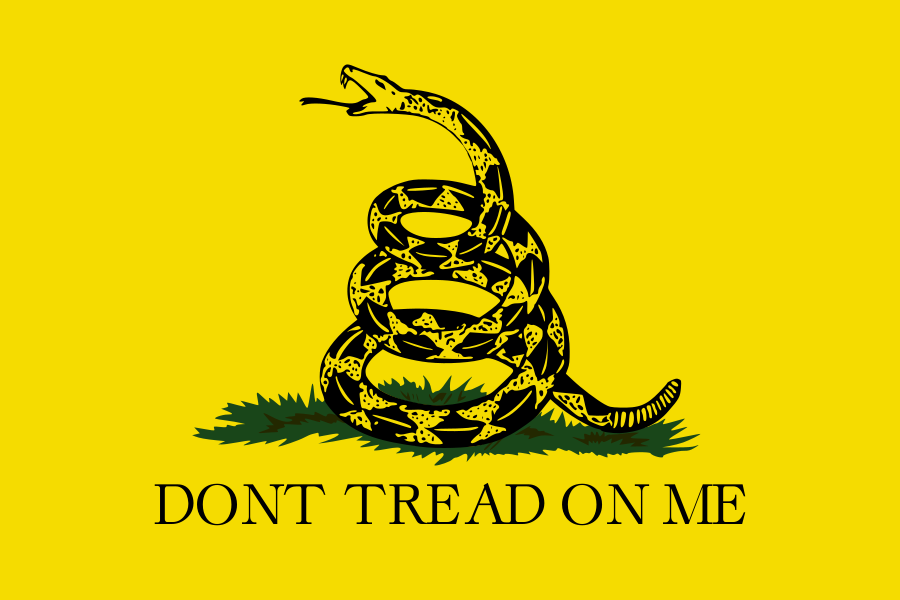
In the autumn of 1775, the thirteen American colonies were at war with the most powerful empire on earth. A provisional Continental Navy was scraping itself together — a handful of merchant ships pressed into service, crewed by men who had been fishermen and dockhands weeks before. To lead them, the Continental Congress appointed Commodore Esek Hopkins of Rhode Island. And to fly from the mainmast of his flagship, a delegate from South Carolina named Christopher Gadsden presented a personal standard of his own design: bright yellow, a timber rattlesnake coiled upon itself, poised to strike, above the motto DON’T TREAD ON ME.
Gadsden was a merchant, an elected official, and a stubborn man. He had been one of the earliest and loudest voices for independence. He served on the Marine Committee. He presented a second copy of the flag to the Provincial Congress of South Carolina, where it was entered into the official journal on February 9, 1776. The design was not idly chosen. Every element of it carried the accumulated meaning of a decade of argument, petition, and grievance.
II. The Rattlesnake Was Already Ours
The symbol did not begin with Gadsden. Twenty-one years earlier, in 1754, Benjamin Franklin had published a woodcut in the Pennsylvania Gazette showing a snake severed into eight pieces, each labeled with the initials of a colony, above the caption JOIN, or DIE. It was an argument for unity in the face of existential threat — at the time, the French and their allies. By the 1770s the same snake, reassembled and alive, had become the colonies’ chosen emblem of themselves.
In December 1775, an anonymous writer signing himself “An American Guesser” — almost certainly Franklin — published an essay in the Pennsylvania Journal explaining, with tongue only partly in cheek, why the rattlesnake was the perfect symbol of the American cause. It is worth reading this passage not as a curiosity but as a founding document of what the flag was meant to say:
“I recollected that her eye excelled in brightness, that of any other animal, and that she has no eye-lids — She may therefore be esteemed an emblem of vigilance. — She never begins an attack, nor, when once engaged, ever surrenders: She is therefore an emblem of magnanimity and true courage. — As if anxious to prevent all pretensions of quarreling with her, the weapons with which nature has furnished her, she conceals in the roof of her mouth, so that, to those who are unacquainted with her, she appears to be a most defenseless animal; and even when those weapons are shown and extended for her defense, they appear weak and contemptible; but their wounds however small, are decisive and fatal.”
“I confess I was wholly at a loss what to make of the rattles, ’till I went back and counted them and found them just thirteen, exactly the number of the Colonies united in America; and I recollected too that this was the only part of the Snake which increased in numbers. . . . ‘Tis curious and amazing to observe how distinct and independent of each other the rattles of this animal are, and yet how firmly they are united together, so as never to be separated but by breaking them to pieces.”
Read it carefully. Every attribute Franklin assigns to the snake is defensive, restrained, collective:
- Vigilance, not paranoia.
- Magnanimity and courage, not bravado.
- She never begins an attack — the aggressor is always someone else.
- Her fangs are concealed, not brandished. She is dangerous only when disturbed.
- She warns before she strikes. The rattle is not a threat; it is a courtesy.
- And the thirteen rattles — the whole point — are distinct yet inseparably united. The snake is strong because the colonies are bound to one another. Break them apart and there is no snake.
That is the grammar of the flag. It is a flag about a people who will not start a fight, will not surrender once engaged, and will not be divided from each other.
III. What, Exactly, Was Being Tread Upon
The motto DON’T TREAD ON ME is not a slogan in the abstract. It responds to specific abuses of power, meticulously catalogued by the colonists themselves. The Declaration of Independence, drafted only months after Gadsden unfurled his flag, reads like an itemized invoice of the treading being objected to:
- The quartering of soldiers in private homes without consent.
- Standing armies kept in peacetime without the consent of the governed.
- The suspension of elected legislatures.
- Trials transported across oceans, away from juries of peers.
- Taxation imposed without representation.
- Writs of assistance permitting general searches at the whim of the crown.
- The obstruction of immigration and naturalization.
- The deliberate incitement of division among the people.
- A chief executive who had “refused his Assent to Laws, the most wholesome and necessary for the public good” and who had “made Judges dependent on his Will alone, for the tenure of their offices.”
This is the treading. The flag is, in its entirety, a protest against concentrated, unaccountable power — whether that power wore a crown, commanded an army, or sat on a bench. It was never a complaint about being asked to contribute to a common project with one’s neighbors. It was never a declaration that any inconvenience constitutes tyranny. It was a warning issued by people who had read Locke and Montesquieu and who knew precisely what tyranny was, because it was garrisoned in their streets.
IV. The Uncomfortable Mirror
Which brings us to the present.
A symbol cannot defend itself from those who appropriate it, and this one has been appropriated strenuously. Somewhere along the way, the coiled snake leapt from the mast of a revolutionary warship onto the back of a lifted pickup truck, onto a license plate frame beside a decal of a punisher’s skull, onto the shoulder patch of a self-styled militia whose members could not, if pressed, name a single grievance in the Declaration of Independence. It flew at rallies for candidates who openly admire foreign strongmen. It was carried through the smashed windows of the United States Capitol on January 6, 2021 — a day on which the flag’s most strident champions did precisely what the men who designed it spent seven years of war trying to prevent: storm a legislature to overturn the voted will of the people.
One does not need to name names to notice the pattern. Observe, without editorial, who waves this flag loudest today, and then ask:
- Who warns against tyranny while cheering the deployment of federal troops against their fellow citizens?
- Who invokes “don’t tread on me” about a public-health measure affecting them personally, and in the next breath demands that the state tread — heavily, specifically — on women’s bodies, on queer and trans lives, on the ballots of neighborhoods they dislike, on books they have not read, on teachers, on librarians, on immigrants who came here for the same reasons their own ancestors did?
- Who claims the mantle of the Minutemen while applauding a would-be executive who promises to prosecute critics, pardon insurrectionists, seize control of independent agencies, and command the military as a personal instrument?
- Who venerates the Founders’ fear of standing armies while insisting that police must never be questioned?
- Who worships rugged individualism under a flag whose entire iconography — thirteen rattles, inseparably joined — is a monument to collective action?
These are not rhetorical flourishes. They are inventory. The flag in its original meaning is a protest against every item on that list. A person who waves it in service of the opposite is not honoring the flag; they are, to borrow Franklin’s imagery, treading on it.
There is a particular, exquisite irony in a movement that calls itself patriotic adopting as its banner a symbol whose defining virtue is that she never begins an attack. The coiled rattlesnake does not invade statehouses. She does not send threats to election workers. She does not cheer when journalists are beaten. She does not applaud the caging of children. She warns, and she defends, and she asks only to be left alone — and extends to her neighbors the same courtesy she asks for herself.
V. What the Flag Actually Asks of Us
Reclaiming the Gadsden flag is not a matter of prying it out of anyone’s hands. It is a matter of reading it honestly and then living up to what it says.
It asks us to be vigilant — not toward our neighbors, but toward power, from whatever direction it comes: state, corporate, theocratic, partisan, populist.
It asks us to be magnanimous — to refuse the first punch, to meet even our opponents with the dignity the cause deserves.
It asks us never to surrender principle under pressure, and never to mistake bluster for courage.
It asks us to keep our weapons — our arguments, our institutions, our capacity for coordinated refusal — in reserve, drawn only when genuinely necessary, and always with a rattle of warning first.
And above all, it asks us to remain distinct but united — thirteen rattles on one tail, a pluralistic people bound to one another across every line someone would like to draw between us. A nation of individuals who understand that solitary rattles make no sound.
That is the flag. That is what it has always said. Anyone who reads it otherwise is welcome to lower it and pick up one of their own.